The Frontier Model War: Grok 4.5 vs GPT-5.6 Sol vs Kimi K3 vs Claude
Three flagships in nine days. Six points of quality separate the whole frontier — and a 25× price gap sits on top. The side-by-side that turns 'which model' into a routing question.

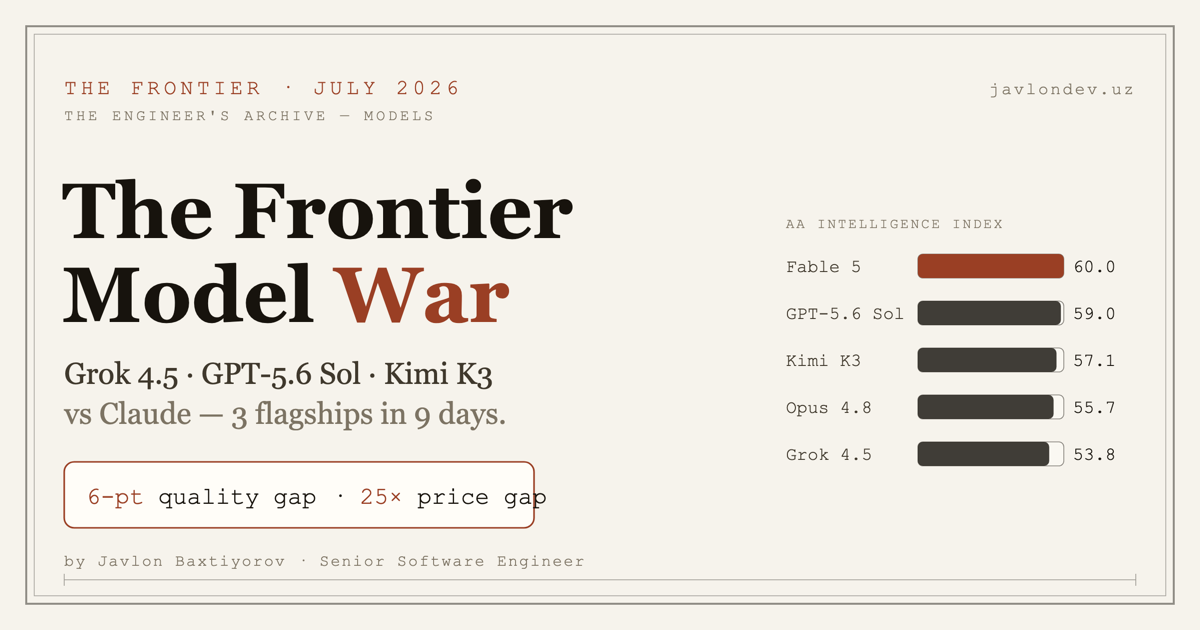
In the space of nine days, the frontier leaderboard was rewritten three times. Grok 4.5 on 8 July. GPT-5.6 Sol on 9 July. Kimi K3 on 16 July. Three labs, three flagships, one crowded fortnight — and the surprising winner is anyone paying an API bill. I put the five models everyone's arguing about side by side, using independent numbers where they exist and flagging vendor claims where they don't.
The overall ranking
Artificial Analysis's Intelligence Index is the closest thing to a neutral, apples-to-apples score. Here's how the five stack up — the spread from top to bottom is barely six points:
Read that gap carefully. Six points separate the most expensive model from the cheapest. A year ago the frontier was a cliff; today it's a gentle slope, and price falls off a cliff long before quality does.
Head-to-head: the numbers that matter
Reasoning — GPQA Diamond (PhD-level science)
| Model | GPQA Diamond |
|---|---|
| GPT-5.6 Sol | 94.6 |
| Kimi K3 | 93.5 |
| Grok 4.5 | 93.1 |
Three models within 1.5 points on the hardest science benchmark in common use. This tier is effectively solved at the top.
Coding — SWE-bench Pro
| Model | SWE-bench Pro |
|---|---|
| Claude Fable 5 | 80.4 |
| Claude Opus 4.8 | 69.2 |
| Grok 4.5 | 64.7 |
| GPT-5.6 Sol | 64.6 |
Fable 5 still owns raw SWE-bench Pro — but it's the priciest model here and its access has been famously unstable. Opus 4.8 is the practical coding default; Grok and Sol trade the next two slots.
Agentic — Terminal-Bench 2.0 (drive a real shell to done)
| Model | Terminal-Bench 2.0 |
|---|---|
| GPT-5.6 Sol | 91.9 |
| Kimi K3 | 88.3 |
| Grok 4.5 | 83.3 |
This is Sol's home turf — it also tops Artificial Analysis's Coding Agent Index at 80. If you're building autonomous coding or computer-use agents, this column is the one to weight.
The part that actually reorders the market: price
Quality converged. Price did the opposite — it fanned out into a 25× spread on output tokens:
| Model | Input $/1M | Output $/1M | Context | Open weights |
|---|---|---|---|---|
| Grok 4.5 | $2 | $6 | 500K | No |
| Kimi K3 | $3 (cached $0.30) | $15 | 1M | Yes |
| Claude Opus 4.8 | $5 | $25 | 1M | No |
| GPT-5.6 Sol | $5 | $30 | 1M | No |
| Claude Fable 5 | $10 | $50 | 1M | No |
Grok 4.5's output is one-eighth of Fable 5's. Kimi K3 throws in open weights. Sol charges the most per output token of the lot — betting it finishes agentic jobs in fewer steps. When the quality gap is six index points and the price gap is 25×, "which model" stops being a leaderboard question and becomes a routing question.
How I'd actually deploy them
There is no single winner — there's a portfolio:
- Hard agentic / computer-use → GPT-5.6 Sol. Best Terminal-Bench and Coding Agent Index; worth the premium when steps-to-done matters more than per-token cost. (full breakdown →)
- Raw coding quality, cost-no-object → Claude Fable 5, with Opus 4.8 as the stable, cheaper default.
- High-volume coding traffic → Grok 4.5. Frontier-adjacent at $2/$6, sitting right inside Cursor. (full breakdown →)
- Open-weight / self-host / data-sovereignty → Kimi K3. Frontier scores, open weights, 1M context. (full breakdown →)
The honest caveats
- Indexes hide task fit. A six-point Intelligence Index gap says little about whether a model handles your prompts, latency budget, and failure modes. Benchmarks start the conversation; your own evals end it.
- Some figures are vendor-reported. GPQA and coding numbers are broadly corroborated; a few agentic scores are still first-party or normalized. Treat the tables as "promising, settling."
- Context windows differ. Grok 4.5 is 500K; the rest are 1M. That matters more for whole-repo work than any single benchmark.
My take
The lesson of this fortnight isn't "model X won." It's that the frontier is now a commodity with a 25× price spread on top of a 6-point quality spread. The teams who win the next year aren't the ones who pick the right model — they're the ones who don't have to. Put every one of these behind a single interface, route each request to the cheapest model that clears the bar, and let three labs compete for your traffic every single week. Portability was a nice-to-have in 2024. In July 2026 it's the whole strategy.
Sources
- Artificial Analysis — LLM Leaderboard and GPT-5.6 has landed
- BenchLM — GPT-5.6 Sol, Grok 4.5, Kimi K3
- Divkix — Best AI models compared, July 2026
- xAI — Grok 4.5 · OpenAI — GPT-5.6 · OfficeChai — Kimi K3
Numbers reflect independent trackers and vendor cards as of 20 July 2026 and will move as boards settle. Spot a corrected figure? Tell me and I'll update.


