Claude Sonnet 5 and the quiet repricing of “good enough”
Anthropic shipped Claude Sonnet 5 on June 30 — near-Opus quality at $3/$15 per million tokens. The interesting part isn't the benchmark. It's what happens to your architecture when the mid-tier model gets this good.


On June 30, 2026 Anthropic released Claude Sonnet 5 (claude-sonnet-5) — a mid-tier model it says performs "close to Opus 4.8, but at lower prices." Introductory pricing runs $2 / million input tokens and $10 / million output through August 31; standard pricing settles at $3 / $15. It's the default on Free and Pro, and available across Max, Team, Enterprise, Claude Code, and the API. Anthropic frames it as agentic: it can "make plans, use tools like browsers and terminals, and run autonomously."
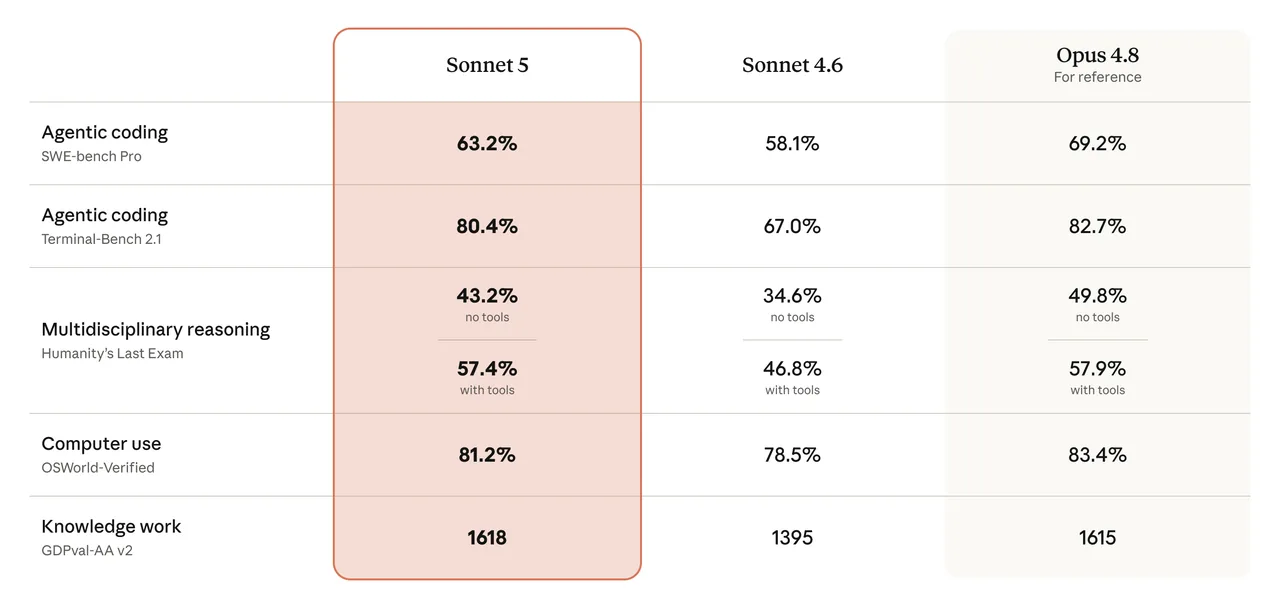
Benchmark comparison as published by Anthropic.
What I take from it
I don't get excited about a single benchmark row. What I watch is the gap between tiers — because that gap is where my architecture decisions actually live.
For two years the pattern has been the same: prototype on the flagship, then spend weeks trying to demote the workload to a cheaper model without losing quality. Every time the mid-tier closes on the flagship, that demotion gets cheaper and those weeks disappear. Sonnet 5 at near-Opus quality for $3/$15 means a lot of work I'd have routed to an expensive model now has a cheaper home that's good enough.
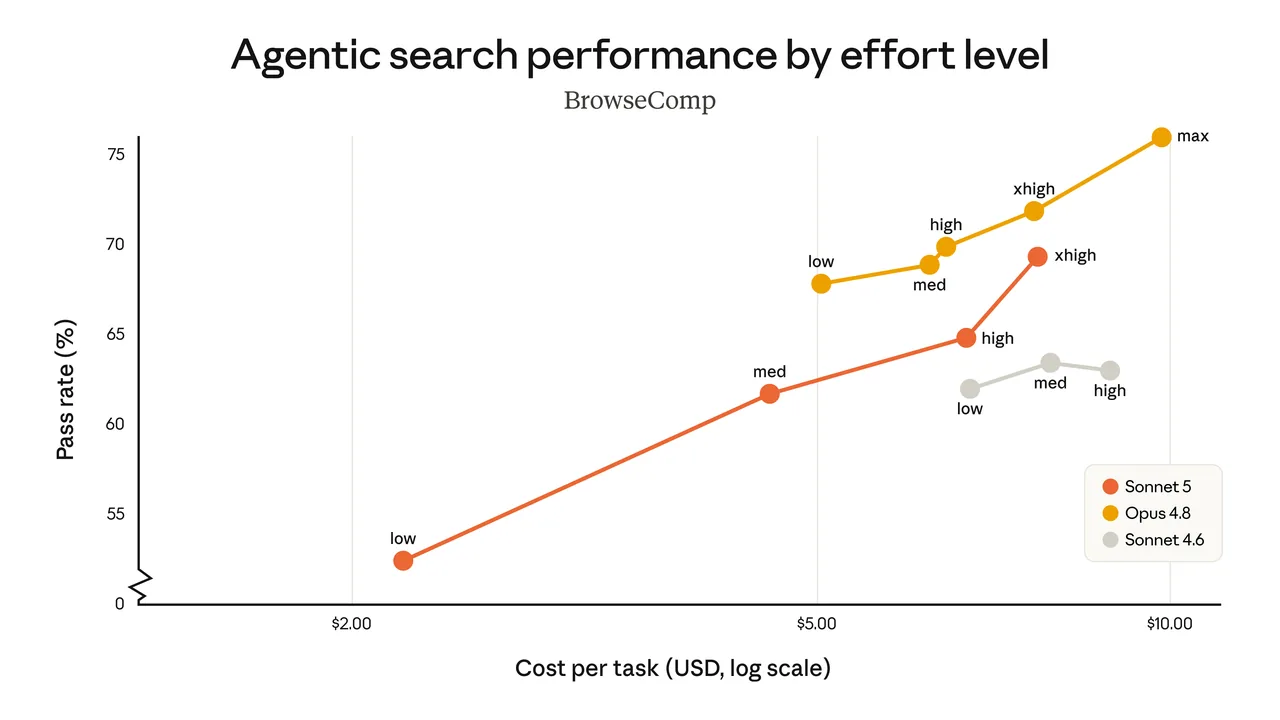
Cost-versus-performance, from Anthropic's launch post.
A few things I'm actually doing with this:
- Re-running my eval set, not the vendor's. "Close to Opus" is their claim on their tasks. The only number that matters is how it scores on mine — so the swap is a config change behind one interface, and the eval gate decides whether it ships.
- Pricing the introductory window as temporary. $2/$10 is a launch promo that expires August 31. I budget on the $3/$15 standard rate so nothing breaks when the discount ends.
- Treating "runs autonomously" as a cost surface, not a feature. Agentic loops with tool use spend output tokens in ways a single call never does. Cheaper per-token is only cheaper if the loop doesn't get longer.
The headline is a model launch. The real event is that the floor under "frontier quality" dropped again — and the systems that benefit are the ones that can move a workload down a tier with a config change instead of a rewrite.
Sources: Introducing Claude Sonnet 5 (Anthropic).


