DiffusionGemma bets the decode bottleneck is in the wrong place
Google DeepMind released DiffusionGemma — an open-weights text model that generates 256 tokens in parallel instead of one at a time, hitting 1,000+ tokens/sec on a single H100. The architecture is the argument.

On June 10, 2026 Google DeepMind released DiffusionGemma, an experimental open-weights (Apache 2.0) text-diffusion model. Instead of generating one token at a time, it produces 256 tokens in parallel per forward pass with full bidirectional attention across the block. The numbers: a 26B-parameter Mixture-of-Experts activating just 3.8B at inference, up to 4x faster generation, 1,000+ tokens/sec on a single NVIDIA H100 and 700+ on an RTX 5090, fitting in 18GB of VRAM when quantized.
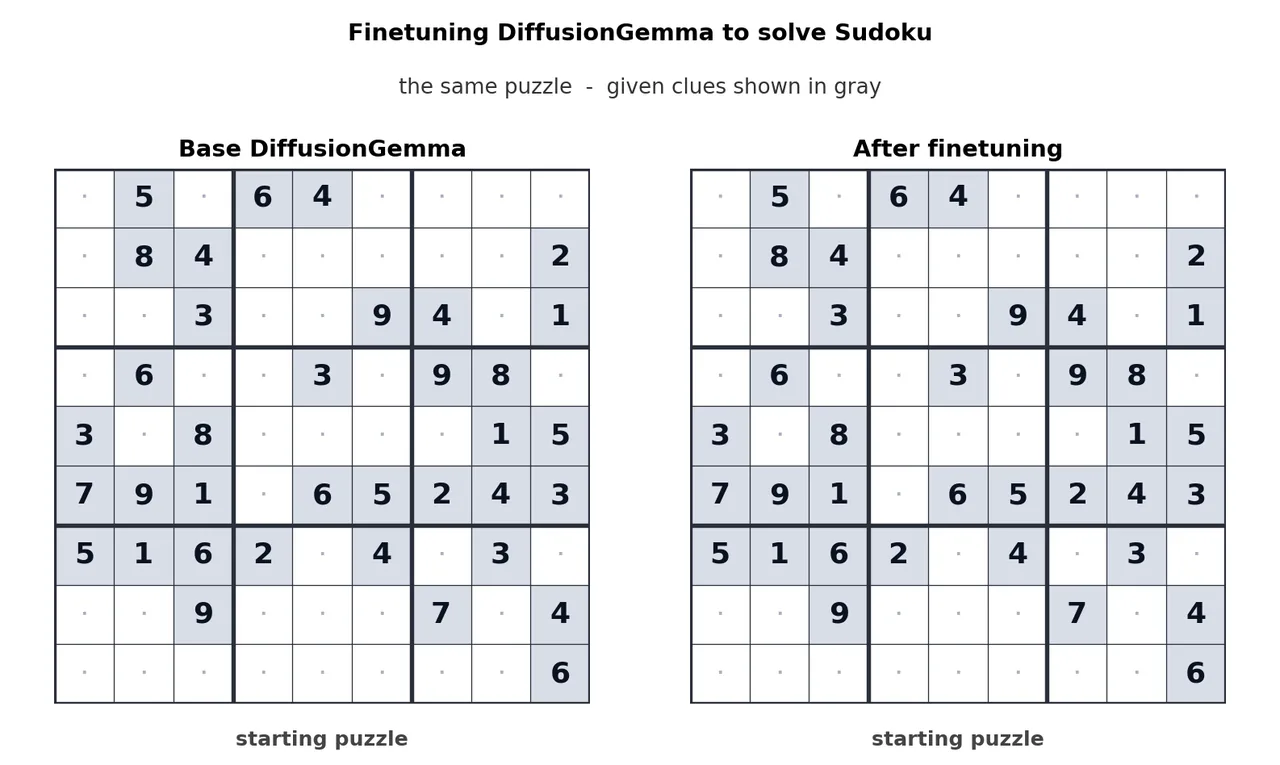
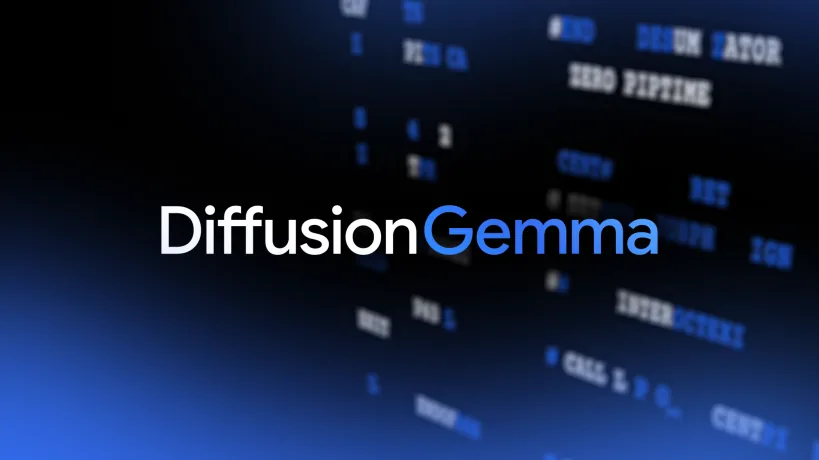
DiffusionGemma denoising a Sudoku grid into a solution (Google DeepMind).
What I take from it
Autoregressive decoding is memory-bandwidth bound: you generate token N, then read the whole model again to generate N+1. DiffusionGemma's claim is that the bottleneck is in the wrong place — shift decode from bandwidth to compute by predicting a whole block at once, and the same hardware runs several times faster.
Why this matters to someone who ships, not just benchmarks:
- Open weights plus 18GB VRAM is the headline I read. A frontier-lab architecture that runs on a consumer 5090 means the experiment is mine to run, on hardware I can actually buy. No API, no rate limit, no model getting deprecated out from under me.
- Throughput, not just latency, changes what's affordable. 1,000 tokens/sec on one H100 reshapes the cost of batch jobs — bulk extraction, transformation, offline pipelines — far more than a chat demo suggests.
- "Experimental" is doing real work in that sentence. Diffusion text models trade some of autoregression's exactness for speed; I'd treat it as a fast path for tolerant workloads, not a drop-in for everything. Bidirectional generation also breaks the token-streaming UX people now expect.
Photo by Taylor Vick on Unsplash.
The reason to pay attention isn't the speed record. It's that the dominant decoding strategy just got a credible, open, runs-on-your-desk challenger. Architectures don't shift often. When one does — and ships under Apache 2.0 — it's worth an afternoon.
Sources: DiffusionGemma: 4x faster text generation (Google), DiffusionGemma model page (Google DeepMind).