Gemini 3.6 Flash vs GPT-5.6, Grok 4.5, Kimi K3 & Claude
The honest comparison: Gemini 3.6 Flash loses on raw intelligence but wins outright on speed (#1/187), holds a 1M context, and has the best cache economics of the fast tier. The real routing table.

Everyone benchmarks Google's new Gemini 3.6 Flash against the crown — Claude Fable 5, GPT-5.6 Sol — and concludes it "loses." That's the wrong fight. Flash is a fast, cheap, mid-tier model, and the honest question is whether it beats the other fast, cheap models you'd actually put it against: GPT-5.6 Luna, Grok 4.5, Kimi K3, and the Claude workhorse tier. I ran the numbers. The answer is genuinely interesting.
The overall ranking (Artificial Analysis Intelligence Index)
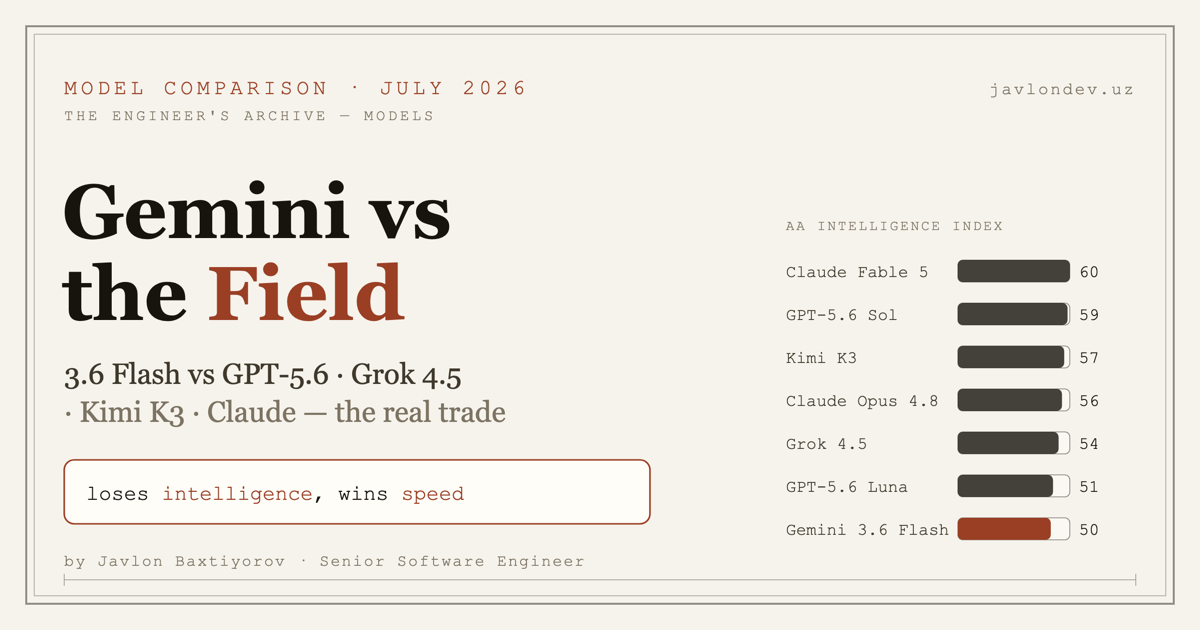
Start with the neutral composite. Here's the current mid-July board, Gemini 3.6 Flash included:
On raw intelligence Gemini is last of this group — but by one point versus GPT-5.6 Luna, OpenAI's own fast tier, and within four of Grok 4.5. The composite hides the trade you actually make, though. Break it into the dimensions.
Speed: Gemini's outright win
This is the one column with no argument. Independent throughput testing, tokens/sec:
| Model | Output speed (tok/s) | Rank |
|---|---|---|
| Gemini 3.6 Flash | 303.6 | #1 / 187 |
| GPT-5.6 Luna | fast tier — trails Flash | — |
| Grok 4.5 | mid | — |
| Kimi K3 | mid | — |
| Claude (workhorse) | mid | — |
Nothing on the board streams faster than Gemini 3.6 Flash. If your product is a streaming chat UI, a tool-calling agent that makes dozens of round-trips, or a batch job measured in millions of tokens, speed is throughput is cost is latency — and Gemini wins it cleanly.
Coding & agentic: the real trade-offs
Here it's a genuine mix — Gemini leads some, trails others:
| Benchmark | Gemini 3.6 Flash | Best of the rest |
|---|---|---|
| SWE-Bench Pro | 58.7 | Grok 4.5 — 64.7 |
| Terminal-Bench 2.1 | 78.0 | GPT-5.6 Luna — 84.7 |
| DeepSWE v1.1 | 49.0 | GPT-5.6 Luna — 67.0 |
| MLE-Bench | 63.9 | Claude Sonnet 5 — 66.9 |
| OSWorld-Verified | 83.0 | Gemini leads |
| GDM-MRCR v2 @ 1M | 54.0 | Gemini leads (1M context) |
Read that honestly. On pure coding agents (SWE-Bench Pro, DeepSWE, Terminal-Bench), OpenAI's Luna and xAI's Grok are ahead — sometimes by a lot (Luna's 84.7 on Terminal-Bench is the class leader). But on computer-use (OSWorld 83.0) and long-context reasoning at a full million tokens (MRCR 54.0), Gemini is the one out front. The pattern: Gemini trades a few points of raw coding for the best speed, the biggest usable context, and the strongest desktop-agent behavior.
Price: the column that reorders everything
| Model | Input $/1M | Output $/1M | Cached input | Context | Open weights |
|---|---|---|---|---|---|
| GPT-5.6 Luna | ~$0.20 | ~low | — | — | No |
| Gemini 3.6 Flash | $1.50 | $7.50 | $0.15 (−90%) | 1M | No |
| Grok 4.5 | $2 | $6 | — | 500K | No |
| Kimi K3 | $3 (cached $0.30) | $15 | $0.30 | 1M | Yes |
| Claude (workhorse) | mid | mid | yes | 1M | No |
Gemini isn't the cheapest sticker price — GPT-5.6 Luna and Grok undercut its output rate. But two things tilt it: the 1M context (double Grok's 500K), and the $0.15 cached-input line, a 90% discount that turns any workload with a stable prefix — a big system prompt, a re-read codebase, a document you query repeatedly — into a fundamentally cheaper model than the sticker suggests. On cost-per-unit-of-throughput, factoring caching, Gemini is very hard to beat.
How I'd actually route between them
There's no winner — there's a routing table:
- Fastest streaming / highest-volume traffic → Gemini 3.6 Flash. #1 speed, 1M context, brutal cache economics. The default for the 80% of requests that don't need the smartest brain.
- Pure coding agents where quality-per-step wins → GPT-5.6 Luna (Terminal-Bench 84.7, DeepSWE 67) or Grok 4.5 (SWE-Bench Pro 64.7). (Grok breakdown →)
- Open weights / self-host / data-sovereignty → Kimi K3, still the only frontier-scoring open model here. (Kimi breakdown →)
- The hard 20% that needs maximum intelligence → a true flagship (Fable 5, GPT-5.6 Sol, Opus 4.8), not any model on this page. (the flagship war →)
- Desktop / computer-use agents → Gemini 3.6 Flash (OSWorld 83.0) is the surprise pick.
The honest caveats
- Composite indexes hide task fit. A one-point Intelligence Index gap between Gemini and Luna tells you nothing about your prompts. These tables start the conversation; your own evals end it.
- Speed rank is throughput, not first-token latency. Gemini's first token can take ~11.5s at high reasoning effort — great for streaming, worth measuring for hard SLAs.
- Some competitor figures are first-party or normalized. The direction is reliable; treat exact decimals as "settling."
My take
Gemini 3.6 Flash doesn't beat the field on intelligence and was never going to. What it does is win the columns that decide production cost — speed, context, and cache economics — while staying within a point or two of the other mid-tier models on quality. In a portfolio-of-models setup, it's the cheapest, fastest lane you pour volume into while the expensive flagships handle the hard tail. That's not a consolation prize. For most real traffic, that's the model you'll actually run.
Sources
- Artificial Analysis — Gemini 3.6 Flash, Intelligence Index leaderboard, and Four frontier launches in eight days
- OfficeChai — Gemini 3.6 Flash benchmarks
- BenchLM — Grok 4.5, Kimi K3
- eesel — Google Gemini 3 pricing 2026
Numbers reflect independent trackers and vendor cards as of 22 July 2026 and will move as boards settle. Spot a corrected figure? Tell me and I'll update.


