Kimi K2.7 Code: The First Open-Weight Model in GitHub Copilot
Moonshot's MIT-licensed, trillion-parameter Kimi K2.7 Code is now selectable in GitHub Copilot's model picker — cheaper, auditable, and self-hostable. Why open weights in the editor is a bigger deal than it looks.

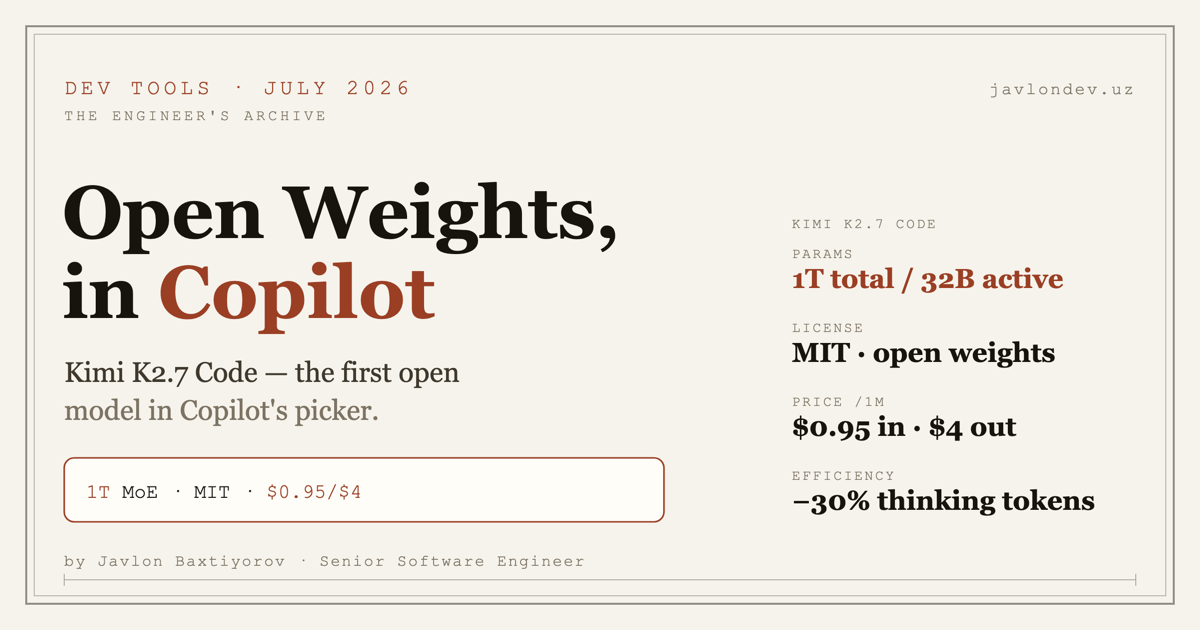
On 1 July 2026, a quiet line appeared in GitHub Copilot's model picker: Kimi K2.7 Code. It's easy to scroll past — until you notice it's the first open-weight model GitHub has ever offered as a selectable option in Copilot. A trillion-parameter, MIT-licensed coding model from Beijing's Moonshot AI, sitting in the same dropdown as the frontier proprietary models — at a fraction of their price. That's a bigger deal than the release notes let on.
What shipped
Kimi K2.7 Code is a mixture-of-experts model with 1 trillion total parameters and ~32 billion active per token — the sparse-activation trick that lets a huge model run at a mid-size model's cost. GitHub made it generally available in the Copilot model picker on 1 July 2026, running a hosted copy on Azure so you don't have to manage infrastructure — but the full 1T weights are public on Hugging Face under an MIT license, so you can self-host if you want.
The generational story is efficiency: K2.7 cuts thinking-token usage ~30% versus K2.6 while scoring higher on every benchmark Moonshot tested. Better answers, fewer tokens — which, in a usage-billed tool like Copilot, is the number that hits your invoice.
Why "open-weight in Copilot" is the actual headline
For a coding assistant, three things change when the model is open:
- Price. Billed at Moonshot's provider list — roughly $0.95 per 1M input / $4 per 1M output — it sits in a lower tier than the frontier proprietary models in Copilot's roster. For high-volume, agentic coding traffic, that gap compounds fast.
- Auditability. The weights are public. You can study it, red-team it, and — critically for regulated shops — run it on your own infrastructure for data-sovereignty, with Copilot's hosted copy as the convenient default.
- Optionality. It breaks the all-proprietary lock-in of the picker. The same portability argument I've made about the frontier model war now reaches inside your editor: route the routine 80% to the cheap open model, save the proprietary flagships for the hard 10%.
Where it fits
Kimi K2.7 Code is a volume workhorse for coding, not a leaderboard-topping generalist. Reach for it when:
- You're running high-throughput agentic coding where per-token cost dominates.
- You want open weights you can inspect or self-host for compliance.
- You're cost-optimizing a Copilot bill and want a capable default for routine edits, refactors, and boilerplate.
Keep a frontier proprietary model one click away in the picker for the gnarly architectural problems — that's the point of a picker. This is the same Moonshot lineage as Kimi K3, tuned for the editor.
The honest caveats
- "Comparable to" isn't "beats." GitHub's framing is strong performance comparable to the top proprietary models — comparable, at lower cost. Benchmark it on your codebase before you switch defaults.
- Hosted ≠ self-hosted behavior. Copilot's Azure-hosted copy is convenient, but if you plan to self-host the 1T weights, the infra bill and latency are yours to size.
- Open weights cut both ways. Auditable and sovereign — but also freely fine-tunable by anyone, so "it's the same model name" doesn't guarantee the same behavior across providers.
My take
The models converging on quality was last year's story. This year's is distribution — and an MIT-licensed trillion-parameter model landing as a first-class citizen in the world's most-used AI coding tool is distribution changing shape. It normalizes open weights in the enterprise editor, it pressures proprietary pricing, and it makes "which model writes my code" a routing decision instead of a vendor lock. If you use Copilot, open the picker, select Kimi K2.7 Code, and run it against your real work for a week. The worst case is you learn where your paid tier actually earns its premium.
Sources
- GitHub (announcement) · AlphaSignal — Copilot adds Kimi K2.7
- TechTimes — open-weight AI enters Copilot
- Kompozy — Kimi K2.7 Code review
Details reflect the 1 July 2026 GA announcement and Moonshot's published pricing as of 29 July 2026. Spot a corrected figure? Tell me and I'll update.


