NVIDIA Nemotron-TwoTower: A Diffusion LLM That's 2.4× Faster
NVIDIA's open-weight Nemotron-TwoTower bolts a trainable diffusion denoiser onto a frozen autoregressive backbone for 2.42× throughput at 98.7% quality — no retraining. The two-tower trick, explained.

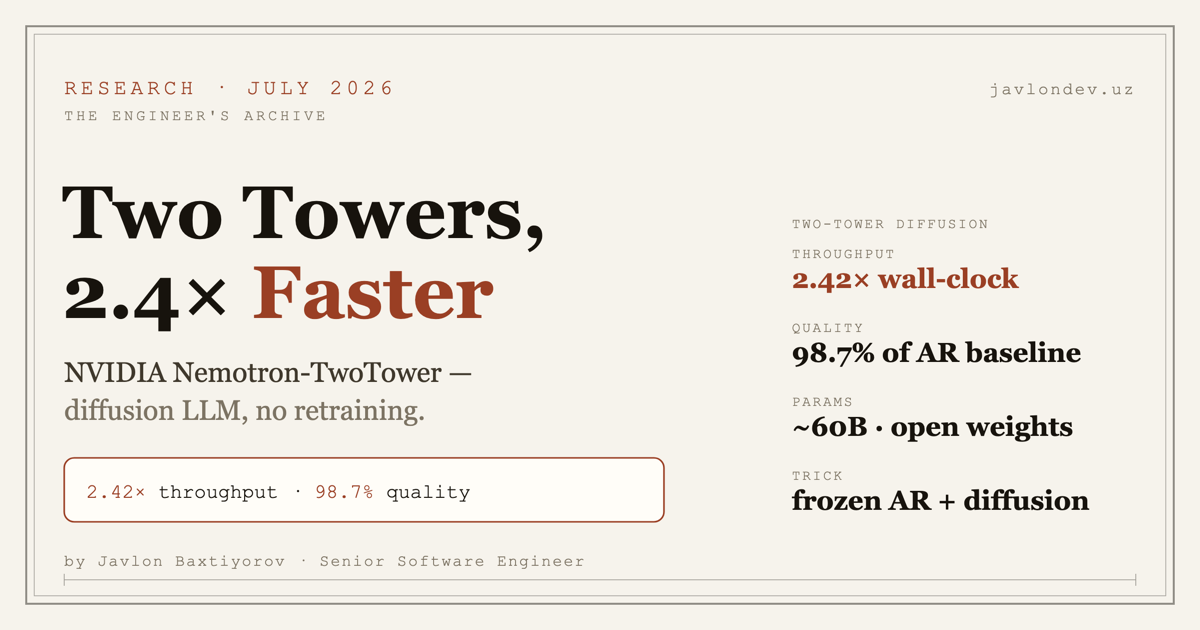
Almost every LLM you've used generates text the same way: one token at a time, left to right. Diffusion language models promise to generate many tokens in parallel — but training one from scratch to match a good autoregressive (AR) model has been the catch. On 1 July 2026, NVIDIA shipped Nemotron-Labs-TwoTower, an open-weight diffusion LM that sidesteps that catch with a clever structural trick: it bolts a trainable diffusion "denoiser" onto a frozen pretrained AR model. The result is 2.42× higher generation throughput at 98.7% of the original quality — without retraining the backbone.
The idea: two towers, one frozen
AR models are strong but sequential — each token waits for the last. Diffusion models refine a whole block of tokens at once (fast, parallel) but historically trade away quality and cost a fortune to train. TwoTower tries to keep both halves' strengths by splitting the roles:
- A frozen AR context tower — the pretrained model, untouched, causally processing the clean tokens generated so far. This is where the language competence lives, and it's never retrained.
- A trainable diffusion denoiser tower — with bidirectional block attention, it refines a noisy block of upcoming tokens, cross-attending to the frozen context tower for grounding.
So it's a block-wise autoregressive diffusion model: generate the sequence block by block (preserving AR-style coherence across blocks), but denoise each block's tokens in parallel (winning the speed). The expensive, knowledge-bearing half is frozen; you only train the cheap denoiser to cooperate with it.
Built on a real backbone
The context tower is Nemotron-3-Nano-30B-A3B — an open-weight 30B hybrid Mamba-Transformer MoE. TwoTower trains the denoiser on ~2.1T tokens. Each tower is 52 layers (23 Mamba-2, 6 self-attention, 23 MoE), and the released checkpoint ships both towers at roughly 60B total parameters under the NVIDIA Nemotron Open Model License.
The reuse-a-frozen-model approach is the practical headline: you don't need a from-scratch multi-hundred-billion-token diffusion pretraining run to get a competitive diffusion LM. You take a good AR model you already trust and teach a small denoiser to parallelize it.
What you give up (honestly)
Parallel decoding isn't free. Measured against its own AR baseline:
| Capability | vs AR baseline |
|---|---|
| General knowledge | within ~1 point |
| Commonsense / multilingual | recovered or improved |
| Code | modest degradation |
| Math | modest degradation |
So it's not a clean win across the board — code and math give a little back, which matters if those are your workloads. But holding 98.7% of overall quality while running 2.42× faster on the wall clock is a genuinely strong trade for throughput-bound, latency-sensitive, or high-volume serving.
Why it matters
Two reasons this is worth a developer's attention beyond the novelty:
- Throughput is cost. In production serving, 2.42× wall-clock throughput is 2.42× more requests per GPU-hour — a direct infrastructure saving for anyone self-hosting inference at scale.
- It's a recipe, not just a model. "Freeze a strong AR model, train a diffusion denoiser to parallelize it" is a transferable technique. Expect it applied to other open backbones — a cheap path to fast variants of models we already have, rather than a moonshot pretraining bill.
The honest caveats
- Research-grade, not a product. This is an open-weight checkpoint and a paper (arXiv 2606.26493), not a hosted API. Serving it well (diffusion decoders have their own kernels and scheduling quirks) is on you.
- Quality is relative to its own baseline. 98.7% of a 30B-class model is not 98.7% of a frontier model — right-size expectations against your current serving model.
- Code/math regressions are real. If those dominate your traffic, benchmark before betting a serving path on it.
My take
The interesting frontier isn't only "bigger and smarter" — it's "same quality, radically cheaper to serve." TwoTower is a clean example: instead of a new giant model, a structural trick that squeezes 2.4× more throughput out of a model class we already have, with open weights so anyone can build on it. For the parts of the stack where you're paying per GPU-hour rather than chasing the last IQ point, this is the kind of unglamorous efficiency work that quietly reshapes unit economics — the serving-side cousin of the routing argument from the frontier model war.
Sources
- arXiv 2606.26493 — Nemotron-TwoTower: Diffusion Language Modeling with Pretrained Autoregressive Context · Hugging Face paper page
- MarkTechPost — NVIDIA releases Nemotron-Labs-TwoTower
- TechTimes — 2.42× throughput without retraining
Figures reflect NVIDIA's release and the accompanying paper as of 29 July 2026. Spot a corrected number? Tell me and I'll update.


